
Leadership is often judged by what people can see.
The decisions made. The conversations held. The targets achieved. The problems solved.
These actions matter, but they are only one part of leadership.
Behind every action is a thought. Behind every thought may be an emotion, assumption or fear influencing how we respond. Strong leadership requires us to pay attention to all three.
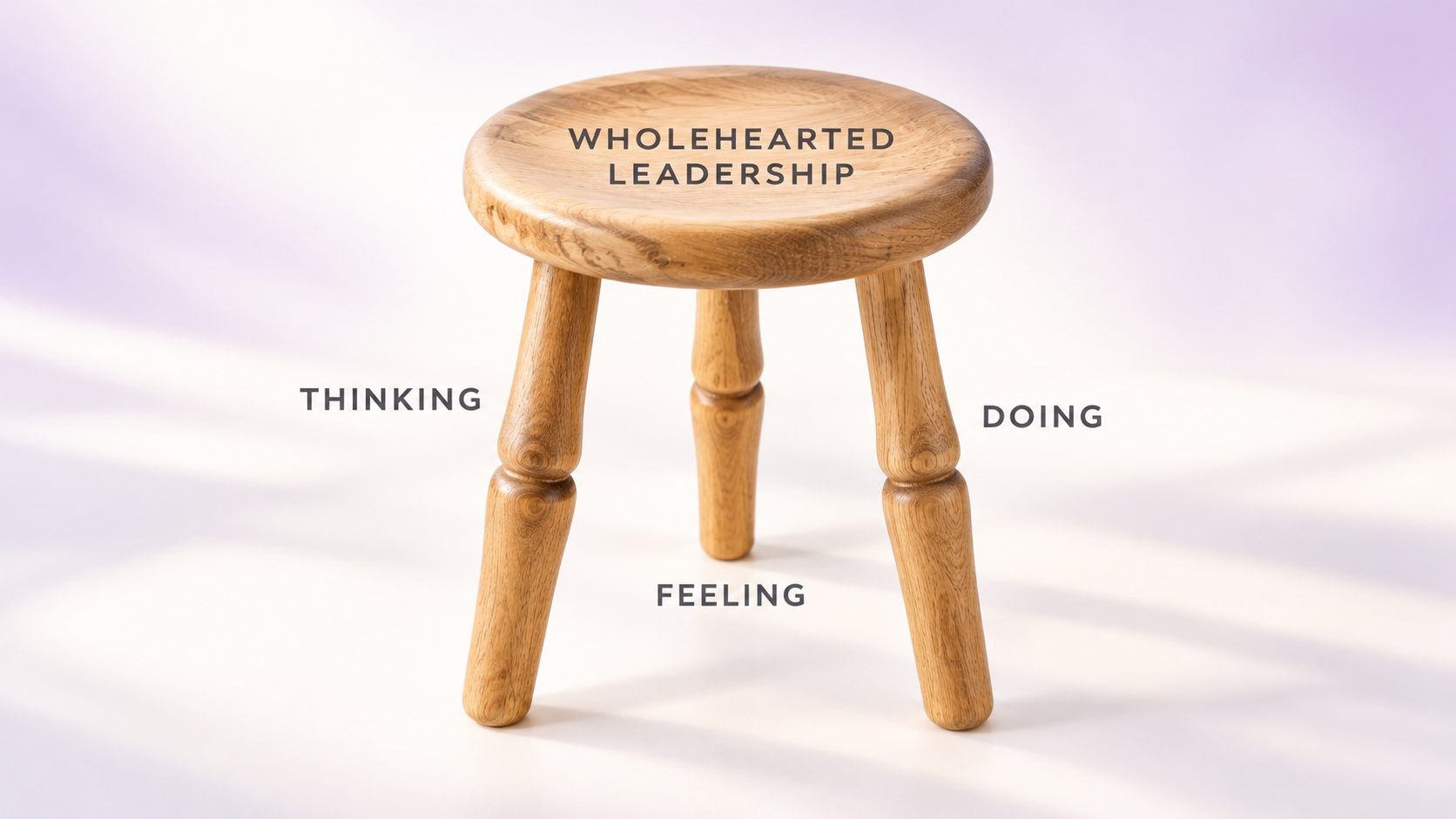
A three-legged stool offers a simple way to understand this.
The seat represents our wholehearted self. It is supported by three legs:
- Thinking
- Feeling
- Doing
Each leg is essential. When one is neglected, the stool becomes unstable. The same is true of leadership.
The Thinking Leg: What Am I Telling Myself?
Thinking includes our beliefs, assumptions, interpretations and internal stories.
When something difficult happens, our minds often try to make sense of it quickly.
A team member misses a deadline, and we decide they are unreliable.
Someone questions our decision, and we assume they do not respect our leadership.
A colleague becomes quiet during a meeting, and we conclude that they are disengaged.
The problem is not that we think. Thoughtful leadership requires analysis, judgement and reflection. The problem begins when we confuse our interpretation with the facts.
Leaders need the ability to pause and ask:
- What do I know to be true?
- What am I assuming?
- Is there information I may be missing?
- Am I approaching this situation with curiosity or certainty?
- How are my previous experiences influencing my interpretation?
This kind of self-awareness helps us respond to what is actually happening instead of reacting to the story we have created around it.
But thinking alone is not enough.
A leader can understand trust intellectually and still avoid the conversation required to repair it. They can read every leadership book available and continue repeating the same behaviour under pressure.
Knowledge becomes useful when it is connected to feeling and action.
The Feeling Leg: What Is Happening Emotionally?
Many leaders have been taught to leave emotion outside the workplace.
They may believe that strong leadership means remaining unaffected, hiding uncertainty or always appearing confident.
But emotions do not disappear because we refuse to name them. They continue to influence our tone, decisions, relationships and behaviour.
Fear can look like control.
Embarrassment can look like defensiveness.
Overwhelm can look like impatience.
Disappointment can look like withdrawal.
When leaders do not recognise what they are feeling, those emotions often lead from behind the scenes.
Emotional awareness is not about allowing every feeling to determine what happens next. It is about developing the language and self-awareness to understand what is present before choosing how to respond.
A leader might ask:
- What am I feeling right now?
- Why has this situation affected me?
- What am I trying to protect?
- Is fear encouraging me to avoid something important?
- What does this emotion need me to notice?
Being able to recognise and name an emotion creates space between the feeling and the response. Within that space, we have more choice.
We can stay curious during disagreement.
We can acknowledge uncertainty without losing authority.
We can receive feedback without immediately becoming defensive.
We can have a difficult conversation without allowing fear to make the decision for us.
That is not emotional weakness. It is emotional responsibility.
The Doing Leg: How Am I Choosing to Respond?
Leadership ultimately becomes visible through behaviour.
Values written on a wall do not create culture. The way leaders behave when pressure rises does.
Trust is built when we keep commitments, respect boundaries, accept responsibility and address problems directly. Courage becomes visible when we speak honestly, ask for help, admit mistakes and remain present during challenging moments.
The doing leg asks:
- What action does this situation require?
- Does my behaviour reflect the values I claim to hold?
- Am I addressing the issue or avoiding discomfort?
- What does my team need to see from me?
- What is the next brave and practical step?
Doing does not always mean taking immediate action.
Sometimes the most responsible choice is to stop, gather more information and consider what the situation genuinely requires. As I explore in The Courage to Pause: Why Strategic Stillness Creates Momentum, a deliberate pause is not the absence of leadership. It can be what allows clearer, more purposeful leadership to emerge.
The goal is not constant activity. It is intentional action.

What Happens When One Leg Is Missing?
A leader who relies almost entirely on thinking may become disconnected from the emotional reality of the people around them. Their decisions may be logical but difficult for others to understand or trust.
A leader who focuses on feeling without reflection may become reactive, take responsibility for everyone’s emotions or avoid accountability to preserve harmony.
A leader who moves immediately into doing may solve the wrong problem, create unnecessary urgency or make decisions that are disconnected from their values.
The stool becomes stable when thinking, feeling and doing work together.
This does not mean achieving perfect balance in every moment. It means noticing when one leg is being ignored and intentionally bringing it back into the conversation.
A Three-Question Leadership Pause
Before responding to a challenging situation, pause and ask:
- Thinking: What do I know, and what am I assuming?
- Feeling: What am I feeling, and what might that emotion be telling me?
- Doing: What action would align with my values and strengthen trust?
Imagine that a reliable employee has recently missed several deadlines.
Your first thought might be, “They no longer care about the quality of their work.”
You may feel frustrated, disappointed or worried about the effect on the rest of the team.
Your immediate impulse may be to send a critical email, quietly take the work away from them or avoid the conversation until the next performance review.
The three-legged stool encourages a more grounded response.
You separate the facts from your assumptions. You acknowledge your frustration without allowing it to control the conversation. Then you choose an action that reflects clarity, accountability and respect.
You arrange a direct conversation. You explain what you have observed, ask what may be contributing to the problem, listen carefully and agree on clear next steps.
These conversations can feel uncomfortable, but postponing them rarely protects the relationship or the team. In fact, avoiding difficult conversations often costs leaders more because the uncertainty, frustration and loss of trust continue to grow.
This is what wholehearted leadership looks like in practice.
How Dare to Lead™ Strengthens All Three Legs
The Dare to Lead™ programme is built on the understanding that courage is not simply something we either have or do not have. Courage consists of skills that can be learned, practised and strengthened.
The programme develops four courage-building skill sets:
- Rumbling with Vulnerability
- Living into Our Values
- Braving Trust
- Learning to Rise
Each of these skill sets brings thinking, feeling and doing together.
Rumbling with Vulnerability
Rumbling with Vulnerability helps us recognise our thoughts and emotions when we face uncertainty, risk or emotional exposure.
It teaches us how to remain engaged instead of armouring up, withdrawing or attempting to control the outcome.
Living into Our Values
Living into Our Values asks us to move beyond naming what matters.
We identify the specific behaviours that demonstrate our values, particularly during difficult moments when those values are tested.
Braving Trust
Braving Trust gives us practical language for understanding how trust is built, damaged and repaired through everyday actions.
It helps leaders and teams move from vague concerns about trust to clearer conversations about the behaviours that need to change.
Learning to Rise
Learning to Rise helps us examine our thoughts, emotions and responses after setbacks.
Instead of becoming trapped in disappointment, blame or shame, we learn how to become curious about what happened, take responsibility for our part and carry the learning forward.
Together, these four skill sets help leaders bring their whole selves to their work.
Understanding Courage Is Not the Same as Practising It
Reading about courageous leadership can strengthen the thinking leg.
Real development begins when we are also willing to engage with what we feel and practise different behaviours.
Courage is a practice. It is developed through the choices we make when we feel uncertain, uncomfortable or exposed.
That is why leadership training matters.
Training creates space to move beyond understanding the ideas and begin applying them to real conversations, relationships, decisions and challenges. It provides the tools, language, reflection and support needed to turn courageous leadership into a daily practice.
As a Certified Dare to Lead™ Facilitator, I help leaders explore these skills in a practical, honest and supportive environment.
This work is not about becoming fearless or having every answer.
It is about learning to recognise what you are thinking, understand what you are feeling and choose actions that reflect who you want to be as a leader.
Because when thinking, feeling and doing support one another, we lead from a more stable place.
We lead with clarity.
We lead with courage.
We lead with our whole hearts.
Explore Dare to Lead™ training with MaryPat Kavanagh and take the next step towards more courageous, connected and wholehearted leadership.