
Leadership often asks us to step into situations where there is no perfect answer.
You may need to begin a difficult conversation, make a decision without having all the information, address a breakdown in trust or guide a team through uncertainty. In moments like these, technical knowledge alone is rarely enough.
We need courage.
But courage is not something a select few are born with. It is a collection of skills that can be learned, practised and strengthened. That belief is at the heart of the Dare to Lead™ programme.
As we prepare to begin the Fall 2026 programme, I have been thinking about what participants are really stepping into. This is more than a leadership course. It is an opportunity to pause, examine how you lead and develop practical ways to respond when leadership becomes uncomfortable.
Leadership Development Begins With Self-Awareness
It is easy to think of leadership development as the process of adding more knowledge, tools or strategies. Those things matter, but meaningful development begins with understanding ourselves.
Before the first Dare to Lead™ session, participants complete reflective pre-work and a Daring Leadership Assessment. They also have an individual mentoring session to consider where they are now and what they want to gain from the programme.
This creates a personal starting point.
Every leader brings different experiences into the room. One person may want to become more confident when addressing poor performance. Another may be learning how to trust their team rather than holding tightly to every responsibility. Someone else may be navigating change, conflict or the pressure to appear as though they always have the answer.
The work becomes more valuable when participants can connect it to the situations they are facing in their own organisations and lives.
Courage Is Not the Absence of Vulnerability
Many of us have absorbed the idea that strong leaders should be certain, composed and in control at all times.
In reality, leadership regularly exposes us to uncertainty, risk and emotional discomfort. We cannot lead people, invite honest feedback, try something new or have a difficult conversation without vulnerability being present.
The question is not whether we can avoid vulnerability. The question is how we will respond when it appears.
Do we become defensive? Do we avoid the conversation? Do we rely on perfectionism? Do we try to control the outcome? Or can we stay curious, grounded and connected to what matters?
Dare to Lead™ helps participants recognise the armour they use to protect themselves and understand how those behaviours may be affecting trust, communication and performance.
The Four Skill Sets of Courageous Leadership
The Dare to Lead™ programme is built around four courage-building skill sets.
Rumbling With Vulnerability
This is about developing the ability to remain present during uncertainty, risk and emotional exposure. It includes approaching challenging conversations with curiosity, asking better questions and listening without immediately becoming defensive or trying to fix everything.
Living Into Our Values
Values are more than words displayed on an office wall. They should help us make decisions, establish boundaries and choose how we behave when we are under pressure.
Participants explore the values that matter most to them and consider how those values can become visible through everyday leadership actions.
Braving Trust
Trust can feel difficult to define, yet it influences almost every part of working life. Teams need trust to communicate honestly, take responsibility, share ideas and work through disagreement.
The programme gives participants a clearer language for understanding how trust is built, where it may be breaking down and what can be done to repair it.
Learning to Rise
Leadership includes mistakes, disappointments and moments when things do not go according to plan. Learning to rise is about recognising the stories we tell ourselves during these experiences, examining them honestly and responding with greater resilience.
It is not about pretending that failure does not hurt. It is about learning how to move through it without allowing it to define what happens next.
This Is Not Passive Training
Dare to Lead™ is not a programme where participants simply watch a presentation and take notes.
The experience includes guided reflection, workbook exercises, conversation and practical application. Participants are invited to examine their leadership habits honestly and consider how they show up when situations become difficult.
That requires participation.
Our Fall 2026 programme is intentionally delivered in a small-group setting. Creating connection within the cohort allows participants to learn not only from the material, but also from one another.
When a leader speaks honestly about a challenge, others often recognise something from their own experience. A situation may be different, but the underlying fears, assumptions or patterns can be surprisingly familiar.
This shared work must take place in an environment where people feel respected, supported and able to participate fully. That sense of safety and connection is an important part of the programme.
Bringing the Learning Back to Work
The value of leadership training is not measured by how much information we remember. It is measured by what changes in the way we lead.
For one participant, that may mean finally having a conversation they have been avoiding. For another, it may mean setting a boundary, asking for help or responding to a mistake without blame.
The work may help leaders:
- Approach difficult conversations with greater clarity
- Build stronger and more accountable relationships
- Make decisions that are aligned with their values
- Recognise when perfectionism or control is getting in the way
- Strengthen trust within their teams
- Recover more constructively from mistakes and setbacks
- Lead without pretending to have every answer
These changes may appear small at first, but they can influence how people communicate, how teams handle pressure and how organisations navigate change.
Courage Is Built One Choice at a Time
One of the reasons I value this work is that it does not present courage as a personality trait reserved for certain kinds of people.
Courage appears in the choices we make every day. It is choosing to be honest when silence would be easier. It is listening when we would rather defend ourselves. It is asking a question when we are expected to know. It is acknowledging a mistake and taking responsibility for what happens next.
We will not make those choices perfectly every time. Courageous leadership is not about perfection. It is about recognising when we have moved away from our values and developing the ability to find our way back.
That is the work participants will begin together in the upcoming Dare to Lead™ programme.
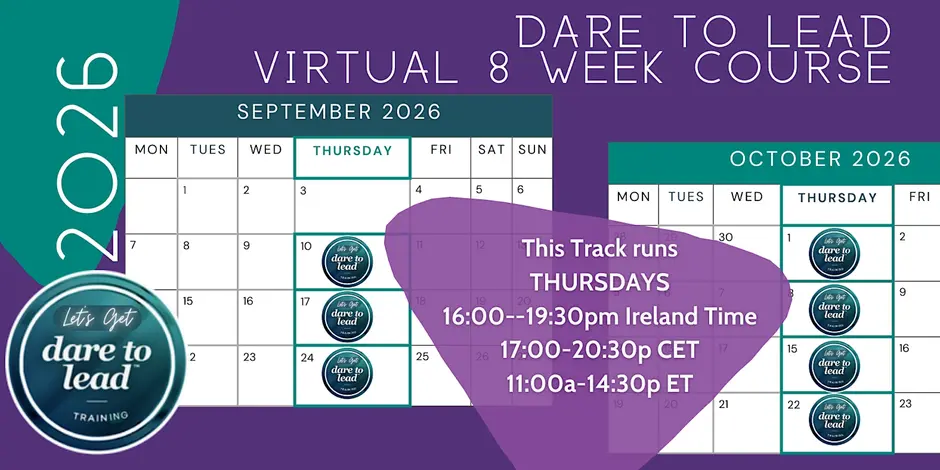
Dare to Lead™ Fall 2026 Programme
MaryPat Kavanagh’s virtual Dare to Lead™ programme runs on Thursdays from September 10 through October 22, 2026. The programme combines facilitated small-group sessions, personal reflection, practical exercises and mentoring.
If you are ready to lead with greater courage, clarity and connection, learn more about the Dare to Lead™ programme or contact MaryPat to discuss a future cohort.