
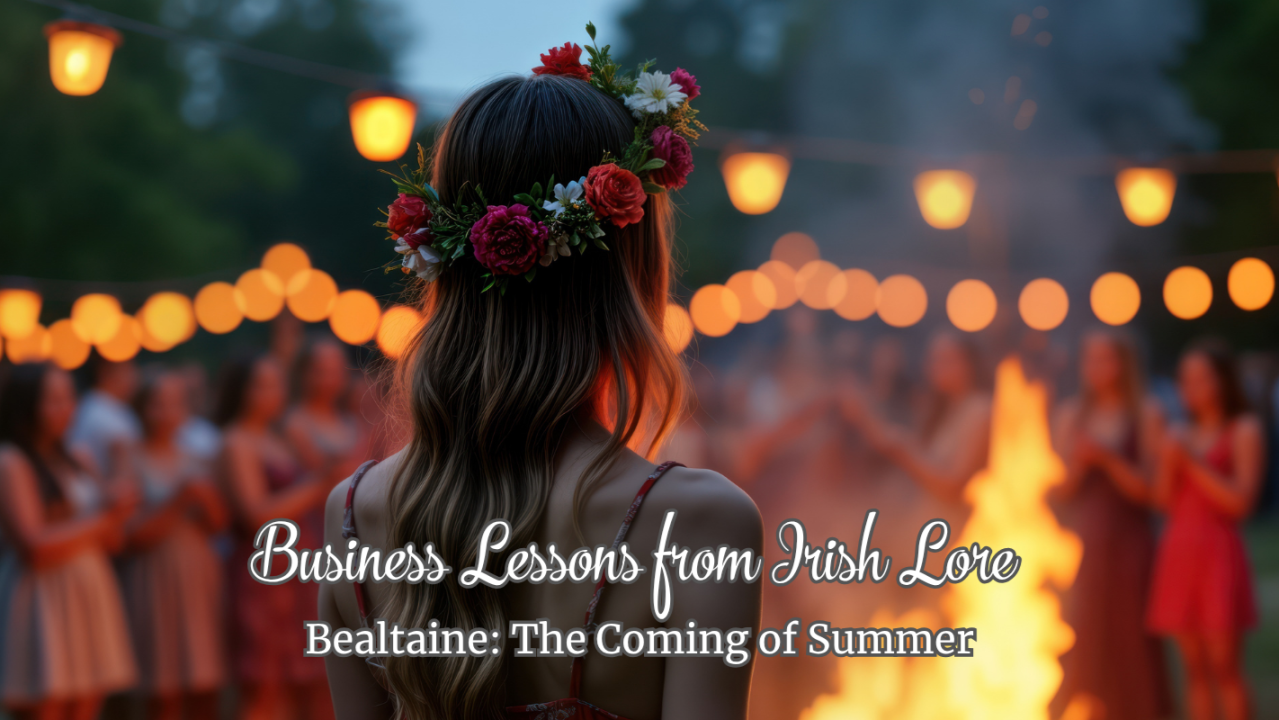
Bealtaine (pronounced BYAL-tin-uh) marks the beginning of summer in the Celtic calendar.
In Ireland, it’s not just a date—it’s a noticeable shift. The days stretch late into the evening. The weather softens. People spend more time outside. There’s a visible change in pace and energy.
Long before modern calendars, this moment mattered in a very practical way.
A Calendar Built on Light and Dark
The traditional Celtic year wasn’t divided into four equal seasons the way we think of it now. It was understood more simply as two halves:
- the darker half of the year
- and the lighter half
Bealtaine marks the move into that lighter half.
It sits halfway between the spring equinox and the summer solstice—a cross-quarter day—used to track seasonal change based on what was actually happening in the natural world, not just a fixed calendar date. This structure of the seasonal year is discussed in works like Ronald Hutton’s The Stations of the Sun, which examines the historical development of seasonal festivals across Britain and Ireland.
This wasn’t symbolic. It was observational.
A Turning Point in Daily Life
Bealtaine signaled a real shift in how people lived.
As the light increased, so did activity:
- More time was spent outdoors
- Work intensified
- Land and animals required more attention
- The rhythm of daily life changed
This wasn’t simply a celebration of summer arriving.
It marked the beginning of the most active phase of the year—something well documented in Irish seasonal accounts, including Kevin Danaher’s The Year in Ireland, which records how rural life followed these seasonal turning points.
Fire and Protection
Fire sits at the center of Bealtaine traditions.
Large fires were lit, often in pairs, on hills or high ground. One of the most well-known practices involved driving cattle between two fires before moving them to summer pasture—a custom widely recorded in Irish folklore collections, including the Duchas Schools’ Collection. 👉 https://www.duchas.ie/en
This wasn’t ceremonial for its own sake.
It was believed to offer protection—particularly against illness—as animals moved into a more exposed environment, a belief also described in Danaher’s work on Irish seasonal customs.
Fire, in this context, marked:
- transition
- protection
- and preparation for what was ahead
Hawthorn and the “Fairy Trees”
Another strong association with Bealtaine is the hawthorn tree.
At this time of year, hawthorn bursts into bloom—white blossoms that stand out across the landscape.
In Irish folklore, hawthorn is closely linked to fairy traditions. Accounts collected in the Duchas Schools’ Collection and described in Dáithí Ó hÓgáin’s The Lore of Ireland identify these trees—particularly when standing alone—as places not to be disturbed. 👉 https://www.duchas.ie/en
Whether taken literally or not, the behavior tells you something important:
Certain elements of the landscape were treated with care and respect.
And Bealtaine was one of the times when that relationship between people and place was most visible.
A Communal Moment
Bealtaine wasn’t private.
It was marked in groups—families, communities, neighbors.
The fires, the movement of animals, the acknowledgment of the season—these were shared experiences. This communal aspect appears consistently across Irish folklore records and seasonal accounts, including those preserved in the National Folklore Collection at University College Dublin. 👉 https://www.ucd.ie/folklore/en/
This mattered, because the season ahead wasn’t something managed individually. It required coordination, awareness, and shared effort.
Bealtaine Today
While the traditional practices aren’t widely carried out in the same way, the pattern hasn’t disappeared.
You can still see it in how people respond to this time of year:
- The first stretch of consistently longer evenings
- Warmer air that changes how people spend their time
- A noticeable shift toward being outside more
- The normalization of stepping away from work to make the most of good weather
In Ireland especially, this is part of everyday life.
It may not be labeled as Bealtaine—but it’s still a response to the same seasonal shift.
Why It Still Matters
Bealtaine is a reminder of something simple:
Seasonal change used to guide behavior.
People didn’t just note that the season had changed—they adjusted how they lived in response.
That connection is less explicit now, but the underlying shifts haven’t gone anywhere.
The light still changes. The pace still changes. The demands of the season still change.
The difference is whether we notice.
You don’t need to light a fire or follow a tradition to mark Bealtaine.
But it’s worth recognizing the shift when it happens.